
Heat Exchangers: More than Just Heat Transfer
Heat Exchangers: More than Just Heat Transfer
When we talk about process plant performance, our attention often goes to reactors, compressors, distillation columns and pumps.
But there is another group of equipment working quietly behind the scenes and playing a vital role in plant efficiency: Heat exchangers.
Heat exchangers are fundamental to refineries, petrochemical plants, fertilizer plants and many other process industries. They heat, cool, condense and vaporize process streams while recovering energy and reducing the consumption of utilities.
A well-designed heat exchanger network can recover heat that would otherwise be wasted and reuse it within the process.
The result? Lower utility consumption, lower operating costs and improved plant efficiency.
A heat exchanger does not have to fail to become a problem
One of the most important things to understand about heat exchanger performance is that the equipment does not have to stop working before it starts affecting plant performance.
Performance can deteriorate gradually due to:
-
Fouling and corrosion
-
Changes in flow rates
-
Changes in process conditions
-
Poor flow distribution
-
Operation away from design conditions
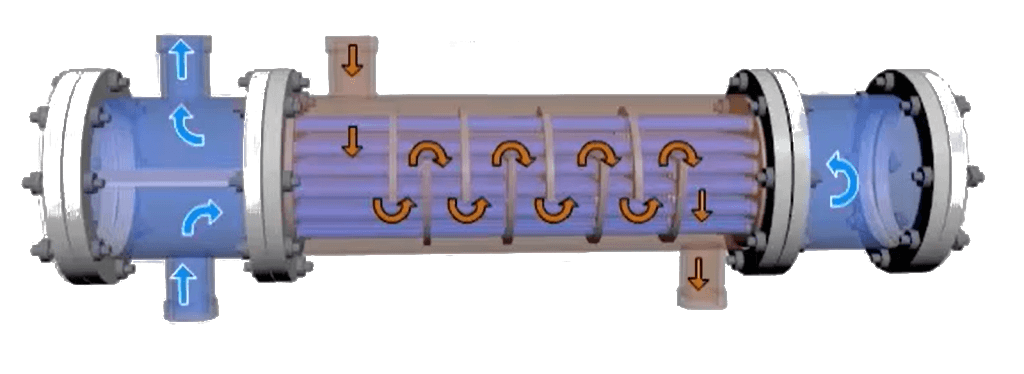
The exchanger may continue to operate normally, while its efficiency is steadily declining.
The symptoms may appear elsewhere in the process: Increasing utility consumption, higher pressure drop, poorer temperature control, reduced energy recovery and increasing operating costs.
By the time the problem becomes obvious, significant efficiency may already have been lost.
Design performance versus operating performance.
So, how do we know whether a heat exchanger is performing as it should?
Looking only at inlet and outlet temperatures is not always enough. Performance needs to be evaluated against the actual operating conditions.
Parameters such as heat duty, overall heat-transfer coefficient, effectiveness, temperature approach, pressure drop, flow rates, fluid properties and fouling resistance can provide valuable insight.
Comparing current performance with expected performance under prevailing conditions can help identify deterioration much earlier.
This is where process simulation and performance monitoring can be particularly useful.
Why understanding equipment behaviour matters
For operators and maintenance personnel, knowing the theory of heat transfer is important. But understanding how the equipment behaves when conditions change is equally important.
For example, if a heat exchanger outlet temperature is lower than expected, several possibilities need to be considered:
Is the exchanger fouled?
Has the process flow changed?
Is the utility supply different?
Has the inlet temperature changed?
Is the exchanger operating away from its design conditions?
Understanding these relationships helps engineers and operators move from simply observing a deviation to understanding its likely cause.
That is an important part of equipment competency – From learning the equipment to understanding its behaviour.
Traditional training often focuses on equipment construction, operating principles and calculations. These are essential, but real plants rarely operate exactly at their design point.
Changing feed conditions, production rates, utility conditions and equipment degradation can all influence performance.
Competency development should therefore also help people understand:
“What happens when operating conditions change?”
Interactive heat exchanger learning modules can take learners beyond the fundamentals and help them explore the operating principles and practical behaviour of heat exchangers through simulation-based learning.
The objective is simple: Not just to know the equipment, but to understand how it behaves.
Ultimately, improving plant performance is not only about having better equipment. It is also about having better-informed people who understand the equipment.